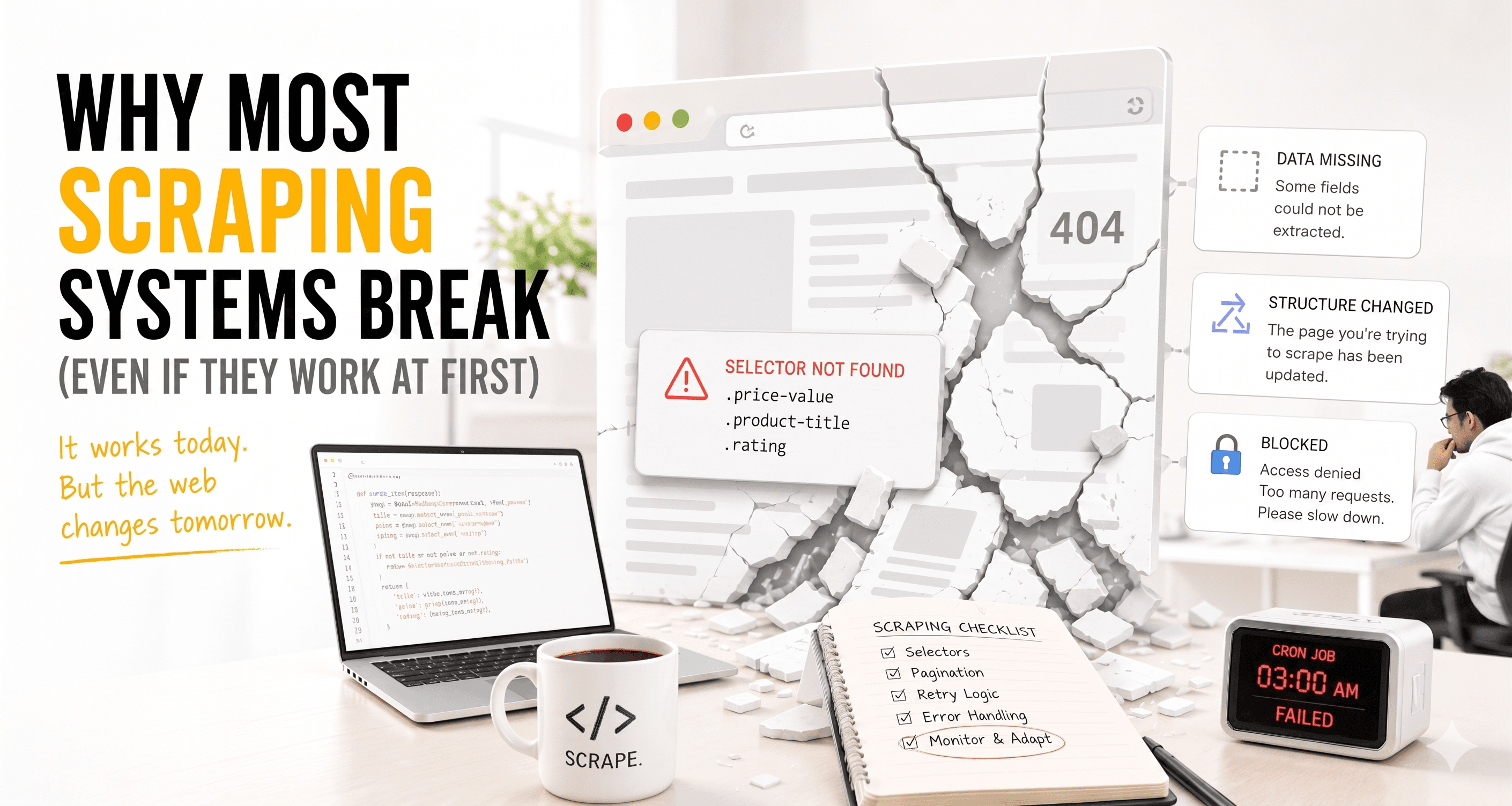
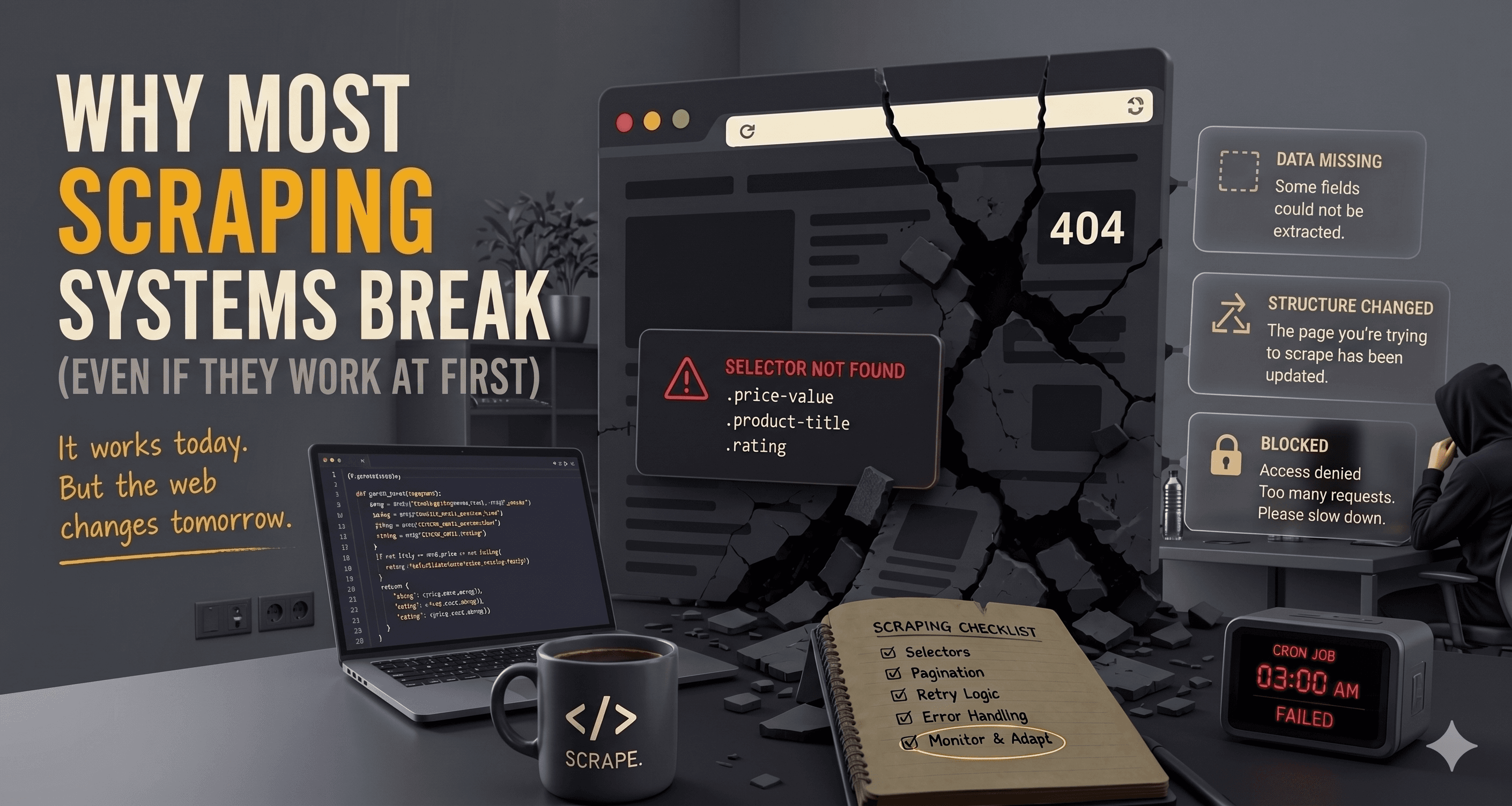
Why Most Scraping Systems Break (Even If They Work at First)
Scraping feels easy until the target moves. On structural volatility, silent failures, retries that mask fragility, and why maintenance—not extraction—is the real product.
Scraping feels deceptively simple at the beginning.
You point a script at a page, extract what you need, store it somewhere, and it works. It feels like you've solved the problem. In many cases, you have—just not permanently.
Over time, I've learned that scraping systems don't usually fail because they were “wrong.” They fail because they were incomplete representations of reality.
And reality is the part that keeps changing.
The illusion of stability
Most scraping pipelines start in a controlled mindset:
- Selectors are correct
- The page structure is known
- The data format is consistent
- The script runs on schedule and produces output
This creates a false sense of durability.
I've seen this across automation systems, especially in environments like reporting pipelines and e-commerce data extraction workflows. At first, everything looks stable enough to treat the system as “done.”
But scraping systems are not software in the traditional sense.
They are agreements with external systems you don't control. And those systems will eventually break that agreement.
The first break always looks random
When scraping systems fail in production, it rarely looks like a clean error.
It looks like:
- Missing fields
- Empty arrays
- Slightly shifted values
- “Sometimes it works, sometimes it doesn't”
In one of my automation setups (involving structured reporting data extraction), a small UI change caused a downstream breakdown that wasn't immediately obvious. The script still ran successfully. No errors. No crashes.
It just started producing subtly incorrect outputs.
That's the most dangerous failure mode in scraping: silent correctness degradation.
Why “working once” is not a signal
A scraping script that works today proves only one thing:
The structure of the page matched your assumptions at that moment.
It says nothing about:
- DOM stability over time
- Backend rendering variability
- A/B testing differences across sessions
- Region-based content variation
- Anti-bot or throttling behavior
This is where most systems quietly accumulate technical debt—not in code quality—but in assumption quality.
The real enemy: structural volatility
From experience building Puppeteer- and Cheerio-based pipelines, the most consistent failure pattern is not complexity—it's change.
Common forms of structural volatility:
- Class names changing without notice
- Nested DOM restructuring (same data, different path)
- Lazy-loaded content shifting timing
- Pagination behavior altering silently
- API responses partially exposed to frontend rendering logic
Even “stable” platforms evolve in ways that break extraction logic without warning. And unlike backend APIs, scraping targets don't version their UI for you.
Why retries don't fix the real problem
A common reaction is to add:
- Retries
- Delays
- Fallback selectors
- Headless vs non-headless switching
These help with symptoms, not causes.
If your system needs retries to succeed consistently, it usually means:
You are compensating for uncertainty instead of eliminating it.
In automation pipelines I've worked on (especially report extraction flows), retries often masked structural fragility. The system appeared “resilient,” but was actually just statistically lucky on repeated attempts.
That's not reliability. That's gambling with better odds.
The hidden cost: maintenance becomes the real product
At scale, scraping systems stop being “data collectors.”
They become:
- Monitoring systems for UI drift
- Repair systems for broken selectors
- Constant adaptation layers over external changes
Most of the engineering effort shifts from building to chasing changes you didn't introduce. This is why scraping systems feel “alive” in a bad way—they require continuous attention, even when the business logic hasn't changed at all.
What actually makes scraping systems survive longer
Over time, the systems that last tend to share a few traits:
- They don't rely on brittle selectors alone.
- They tolerate partial failure instead of collapsing completely.
- They isolate extraction logic from downstream processing.
- They assume change, not stability.
More importantly, they treat external structure as probabilistic, not fixed. In practical terms, that means designing pipelines that degrade gracefully rather than break sharply.
The uncomfortable truth
Scraping is not a data problem. It's a maintenance problem disguised as a data problem. And the better your scraper is at the beginning, the more dangerous it becomes later—because it encourages the belief that the system is stable when it's only temporarily aligned with reality. That's the part that took me the longest to internalize.
Closing thought
A scraping system that works today is not done. It is simply: correctly aligned with a moving target—for now.
And in practice, most of the engineering effort is not in making it work. It's in making sure it doesn't silently stop working while still convincing you that it is.