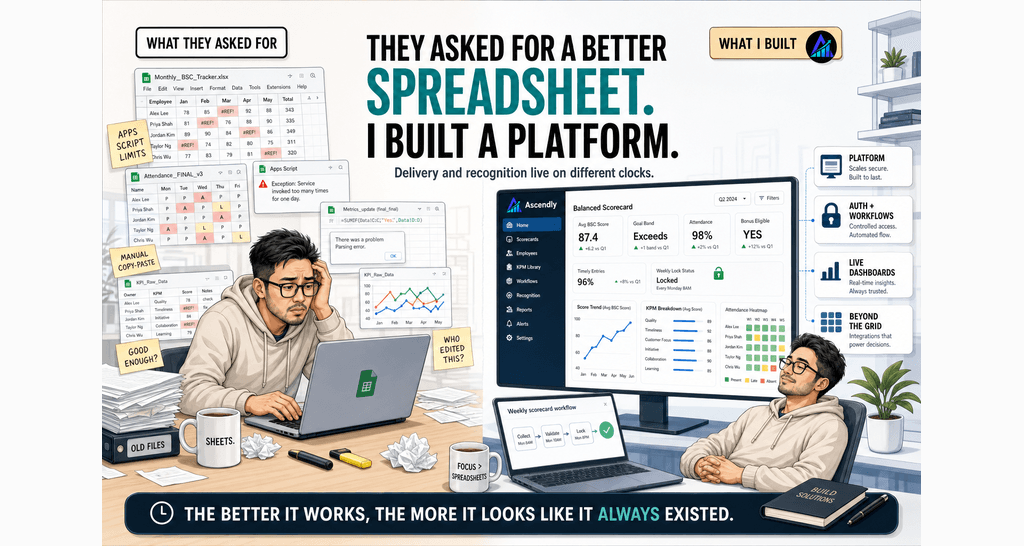
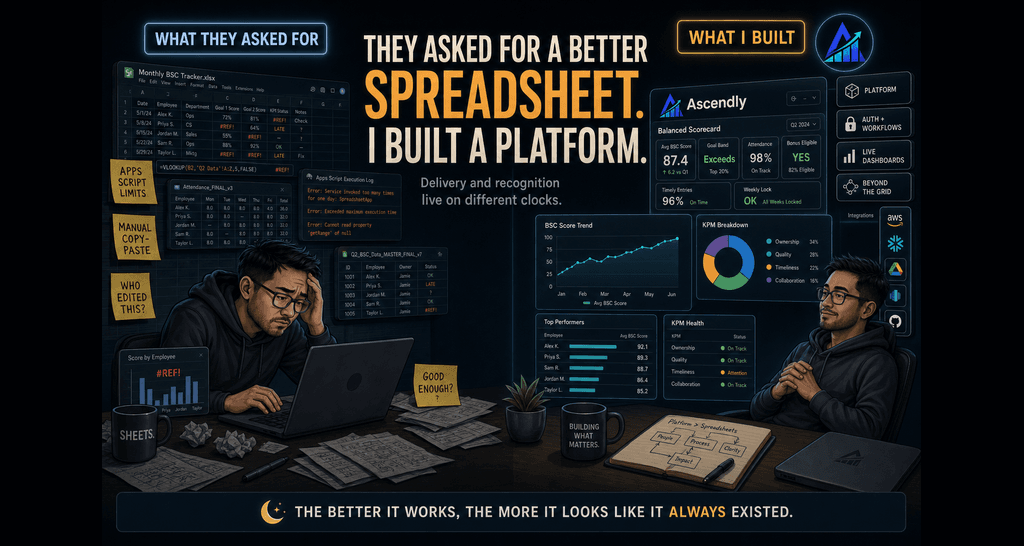
They Asked for a Better Spreadsheet. I Built a Platform.
A reasonable ask—“make this less painful than Sheets”—became Ascendly. On under-naming platforms, quiet adoption, and the weird tax of raising the ceiling too successfully.
There's a special kind of project that starts with a reasonable sentence:
Can we make this less painful than Sheets?
It sounds small. Contained. Almost polite.
What they often mean is: keep the mental model, remove the suffering. Same rituals—fewer broken formulas, fewer “who edited this?” moments.
What I heard—and what I built—was something else.
I didn't ship a prettier grid. I shipped a platform.
The old world was honest about its pain
Before Ascendly, employee metrics lived where a lot of internal truth lives: spreadsheets, stretched by Apps Script until the seams showed.
It worked. Kind of. Until it didn't—quietly, repeatedly, in ways that never became tickets because “that's just how we do it.”
Pain was visible. Pain got urgency. Nobody mistook the spreadsheet for a product.
Then the ceiling moved—and the vocabulary didn't
Ascendly wasn't “Sheets with a login.” It went past what the old BSC could do.
I expected—maybe naively—a moment where the room said: we don't live in that old world anymore.
Sometimes that moment is quiet. Sometimes it never arrives in the form you imagined.
Time to build was tight. Pressure was real. I shipped anyway.
What followed wasn't rejection. It was quieter: under-naming. The system got treated like an upgrade to the spreadsheet—not like a new layer the organization now stood on.
Delivery and recognition live on different clocks. One can finish in a sprint. The other can take a year—or never get scheduled.
That's the trap of raising the ceiling too successfully. When the old pain disappears, so does the contrast. People stop comparing the new system to Sheets. They start comparing it to an imaginary perfect tool that always existed in their head.
Orgs undervalue platforms once the old pain is gone.
Appetite isn't applause
Every enhancement invites another. That's healthy. It means people are living inside the tool, not around it.
I don't resent the backlog. I understand it.
What confused me was the emotional math: requests kept arriving, while credit for the platform itself stayed thin.
Those two facts can coexist.
Adoption looks like feature requests, not thank-yous.
If you wait for applause to feel that the work mattered, you'll misread your own success.
Ambition needs a mandate
Ascendly still has room to grow—integrations, deeper automation, connections I can already picture.
I'm just not always sure whether to keep pushing that future, or let the current setup breathe.
So I've landed here:
- Stabilize what exists. Make it trustworthy.
- Park the big bets behind a real yes—time, ownership, priority.
Without that, a roadmap becomes something you carry alone. That's not vision. That's unpaid emotional labor dressed as backlog.
Closing
They asked for a better spreadsheet. I built a platform.
I'm still proud of that—even on the days when the org's vocabulary hasn't caught up. Pride doesn't require a parade. It does require clarity: about what you shipped, what you'll keep carrying, and what you'll only build when the work is named for what it is.
One last thing
The better the system works, the more it looks like it was always supposed to exist.
That's not failure. That's the weird tax on doing the job well.
Don't let a small request shrink the meaning of the delivery. And don't let a quiet room convince you the leap didn't happen.
It did.