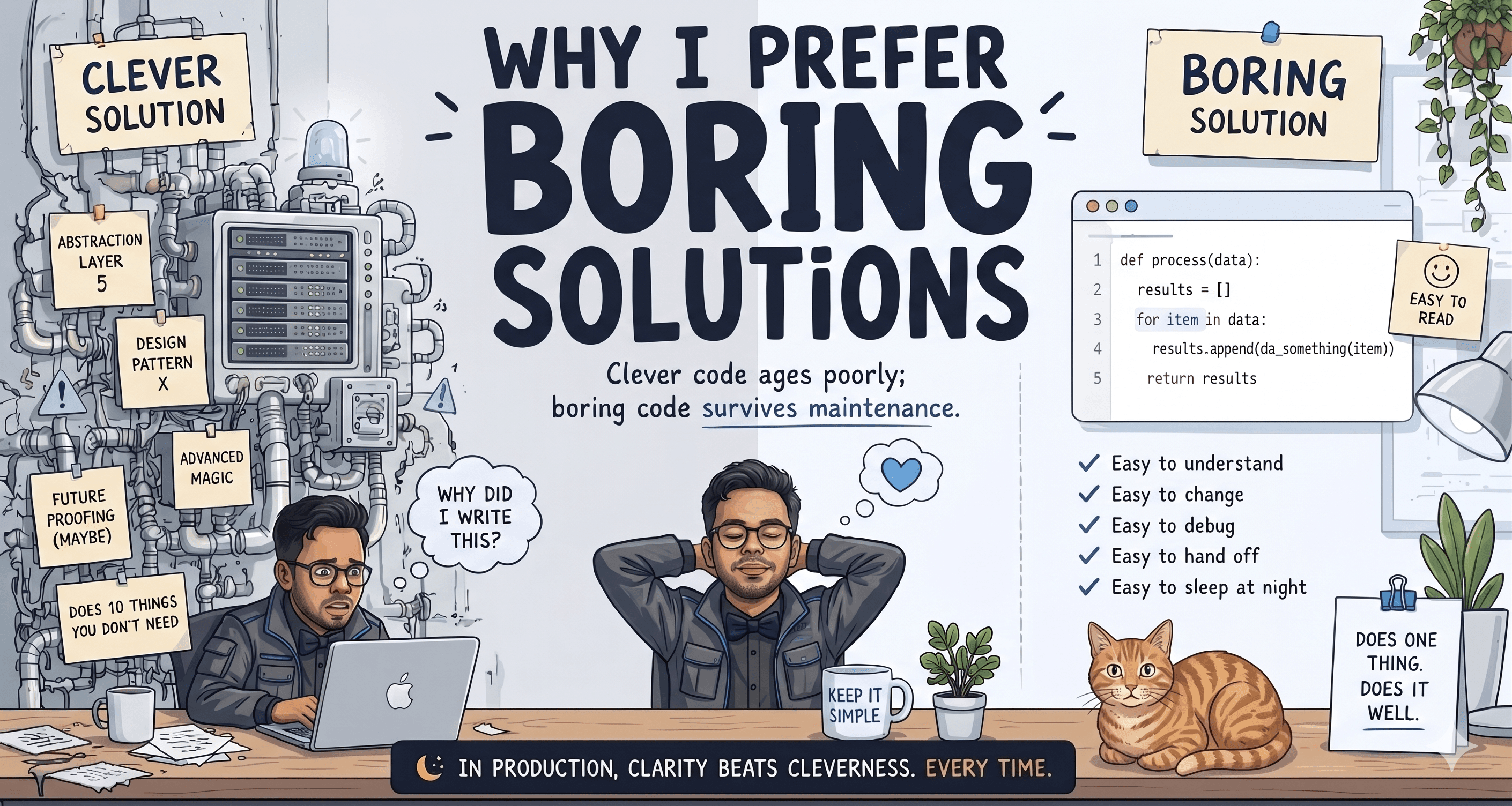
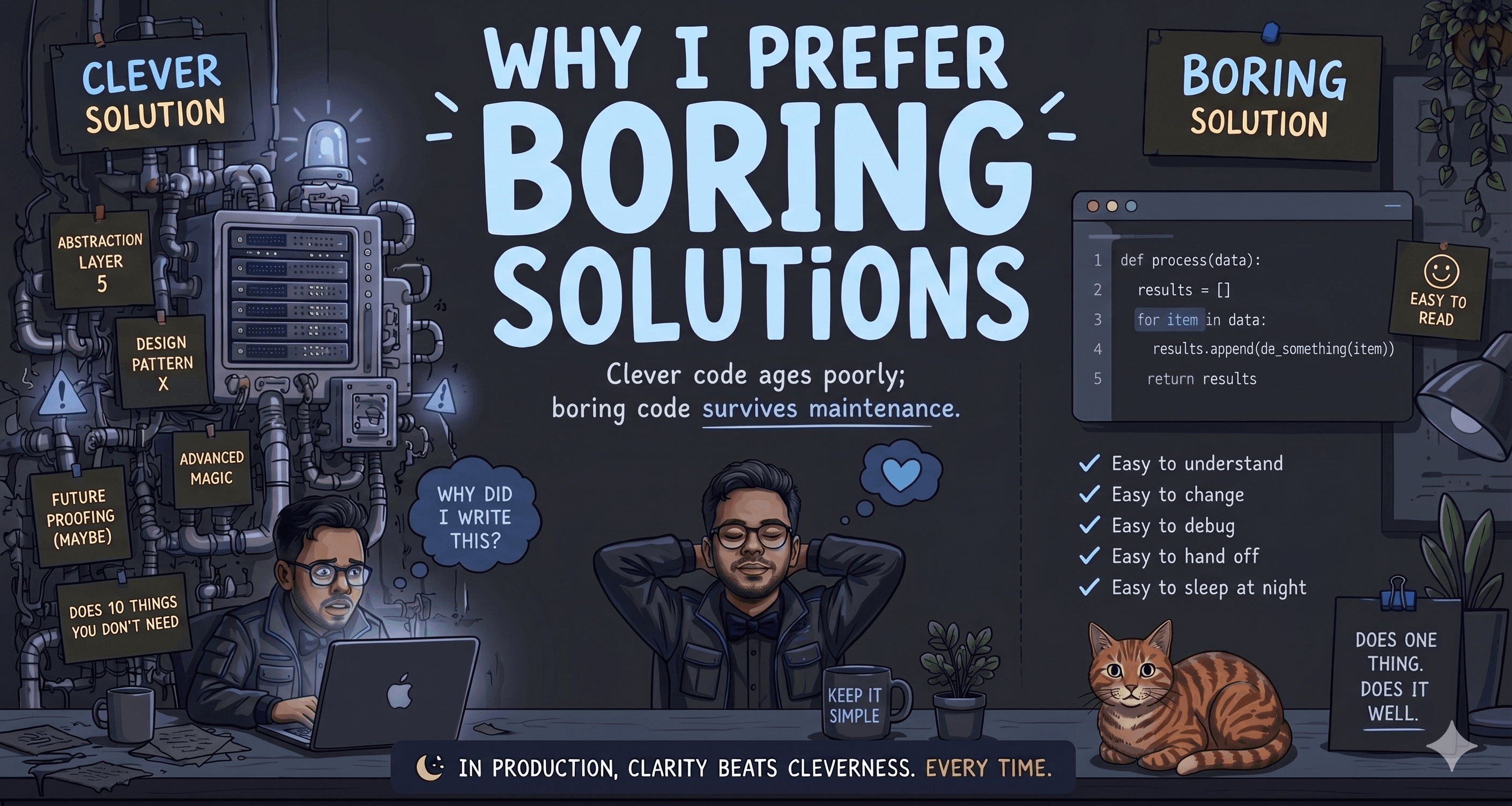
Why I Prefer Boring Solutions
Clever code ages poorly; boring code survives maintenance. On readability, future-proofing myths, AI-generated complexity, and why the dull solution is often the reliable one.
At some point, I stopped trying to write impressive code.
Not because I couldn't—but because I realized something uncomfortable:
The more “impressive” a solution looks, the more likely it is to become a problem later.
These days, I prefer boring solutions.
Not basic. Not lazy. Just… boring.
What “boring” actually means
Boring solutions are:
- easy to read
- predictable
- obvious in behavior
- uninteresting to explain
If someone opens your code and immediately understands what it does without asking questions—that's boring.
And that's exactly the point.
The trap of clever code
There's a certain satisfaction in writing something concise and “smart.”
You compress logic into fewer lines. You use advanced patterns. You make it look elegant.
Until someone else reads it.
Or worse—you read it again after two weeks.
Suddenly, you're debugging your own creativity.
I've done this before. Thought I wrote something clean, only to come back later and think:
Who wrote this… and why are they like this?
Turns out, it was me.
Readability scales. Cleverness doesn't.
In real systems
Especially automation pipelines, scraping flows, and reporting tools—the problem isn't writing code.
It's maintaining it.
Boring code wins because:
- it's easier to debug
- easier to extend
- easier to hand off
- harder to misunderstand
You don't need to mentally execute the code to understand it.
It just… reads like it works.
You don't need “perfect” code—you need working systems
One shift that changed how I build things:
Focus on the goal. Not on making the code look impressive.
That means:
- no unnecessary abstractions
- no over-optimized one-liners
- no patterns added “just in case”
I'd rather write slightly longer code that's obvious, than shorter code that needs explanation.
Because in production: clarity beats cleverness every time.
The myth of future-proofing
There's a common instinct to “design for the future.”
Add flexibility. Add extensibility. Add layers so it can scale later.
Sounds responsible.
But most of the time, it turns into:
building solutions for problems that don't exist yet
I've done this too—adding configs, abstractions, and structures for “future use.”
And guess what?
The future didn't use them.
Or worse—the actual requirements changed, and all that “future-proofing” became irrelevant.
You can't predict the future—but you can adapt to it
Instead of trying to build for every possible scenario, I've learned to optimize for something simpler:
Make the current system easy to change.
That's it.
Because in real projects:
- requirements shift
- data changes
- priorities move
- systems evolve
The best systems aren't the ones that predicted the future.
They're the ones that didn't fight it when it arrived.
Where AI makes this worse (sometimes)
With tools like GitHub Copilot or Cursor, it's easier than ever to generate “impressive-looking” solutions.
You ask for something simple… and get a fully abstracted, multi-layered implementation.
It works. It even looks clean.
But it often solves more than what you asked for.
That's where things get risky.
Because:
complexity generated is still complexity you have to maintain
AI doesn't feel that cost. You do.
Boring scales better than smart
In systems I've worked on—especially ones that run daily, process data, or depend on external inputs—the solutions that last are never the most elegant ones.
They're the ones that:
- do one thing clearly
- fail in predictable ways
- are easy to fix at 3 AM
(That last one matters more than people admit.)
A simple rule I follow now
If a solution makes me pause and think:
“This is kinda clever”
I usually rewrite it.
Not always—but often enough.
Because that pause is a signal:
Someone else will pause longer.
Closing thought
Boring solutions don't get attention.
They don't look impressive in code reviews. They don't feel exciting to write.
But they do something better:
they keep working
And in the end, that's the only thing that really matters.